複習:成長曲線的百分位 percentile 與標準差 standard deviation 怎麼互換?
文獻英文摘要
Background: To develop new growth chart references for height, weight, and body mass index (BMI) for children aged 0-5 years in the Taiwan Birth Cohort Study (TBCS) and to compare these references with both 1997 Taiwan references and World Health Organization (WHO) standards.
Methods: Data were obtained from the TBCS of a nationally representative sample of 24,200 children. A total of 18,466 children completed the baseline survey at 6 months of age and three follow-up surveys at 18 months, 3 years, and 5.5 years of age. The modified LMS method was used to construct percentile curves by sex, including length/height for age, weight for age, and BMI for age.
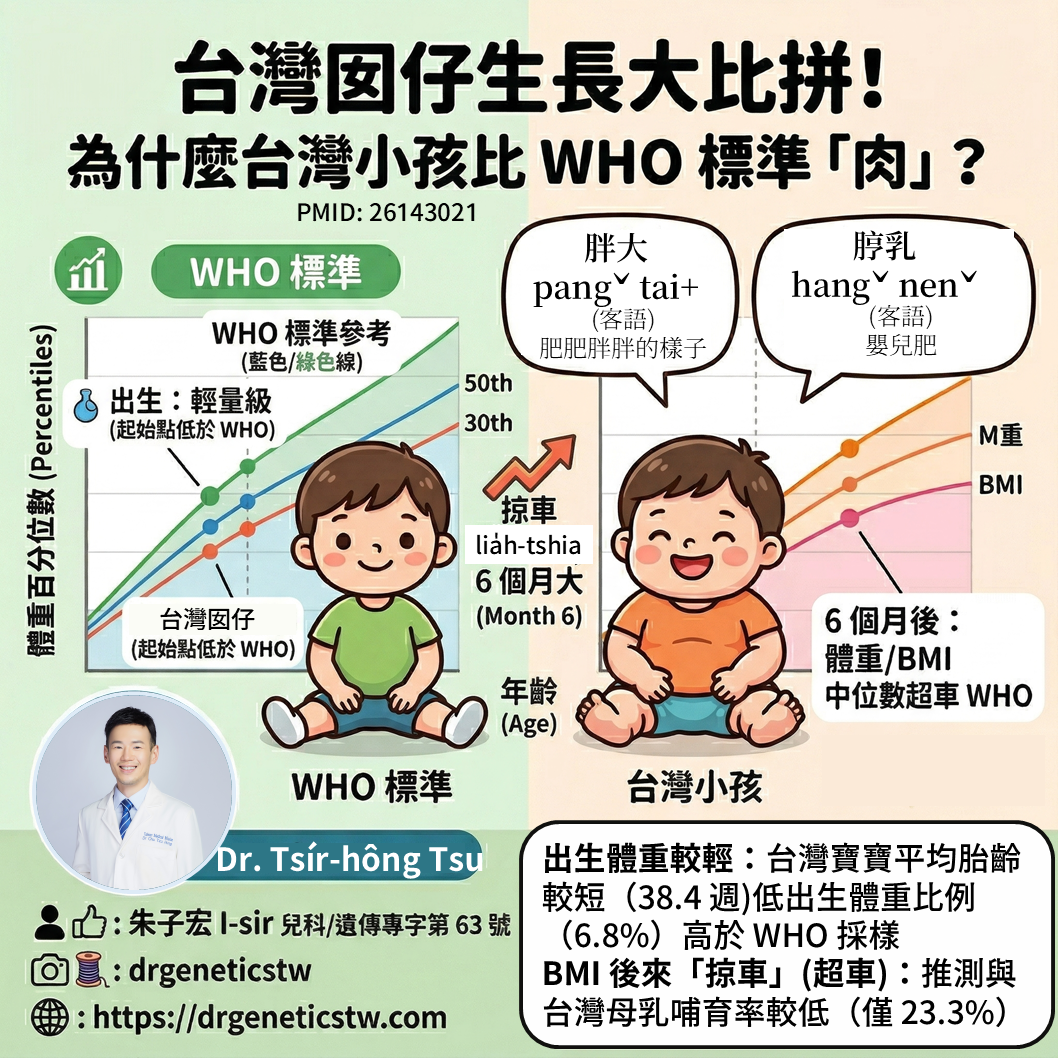
Results: TBCS children of both sexes were shorter and lighter at birth compared with 1997 Taiwan references and WHO standards. The growth patterns of TBCS children were close to those of the 1997 Taiwan references after 6 months of age. Compared with WHO standards, however, TBCS children were heavier after 6 months of age.
Conclusion: This study has developed TBCS references to monitor the growth of children in Taiwan, whose weight growth patterns differed from those “prescribed” by WHO standards.
Discussion
We developed TBCS child growth charts for length/height, weight, and BMI for age based on a nationally representative cohort of children born in 2005. TBCS ref erences were close to the 1997 Taiwan references in all age groups and in both sexes, although TBCS children were both shorter and lighter at birth. Compared with WHO standards, TBCS children had similar patterns of length/height growth but were heavier in all age groups except at birth.
Why were TBCS children shorter and lighter at birth than children of both the 1997 Taiwan references and the WHO growth chart? There are several possible explanations. First, compared with the 1997 Taiwan references,24 TBCS chil dren had shorter gestational periods. The mean gestational age of the TBCS children was 38.4 weeks, whereas the 1997.


發表迴響