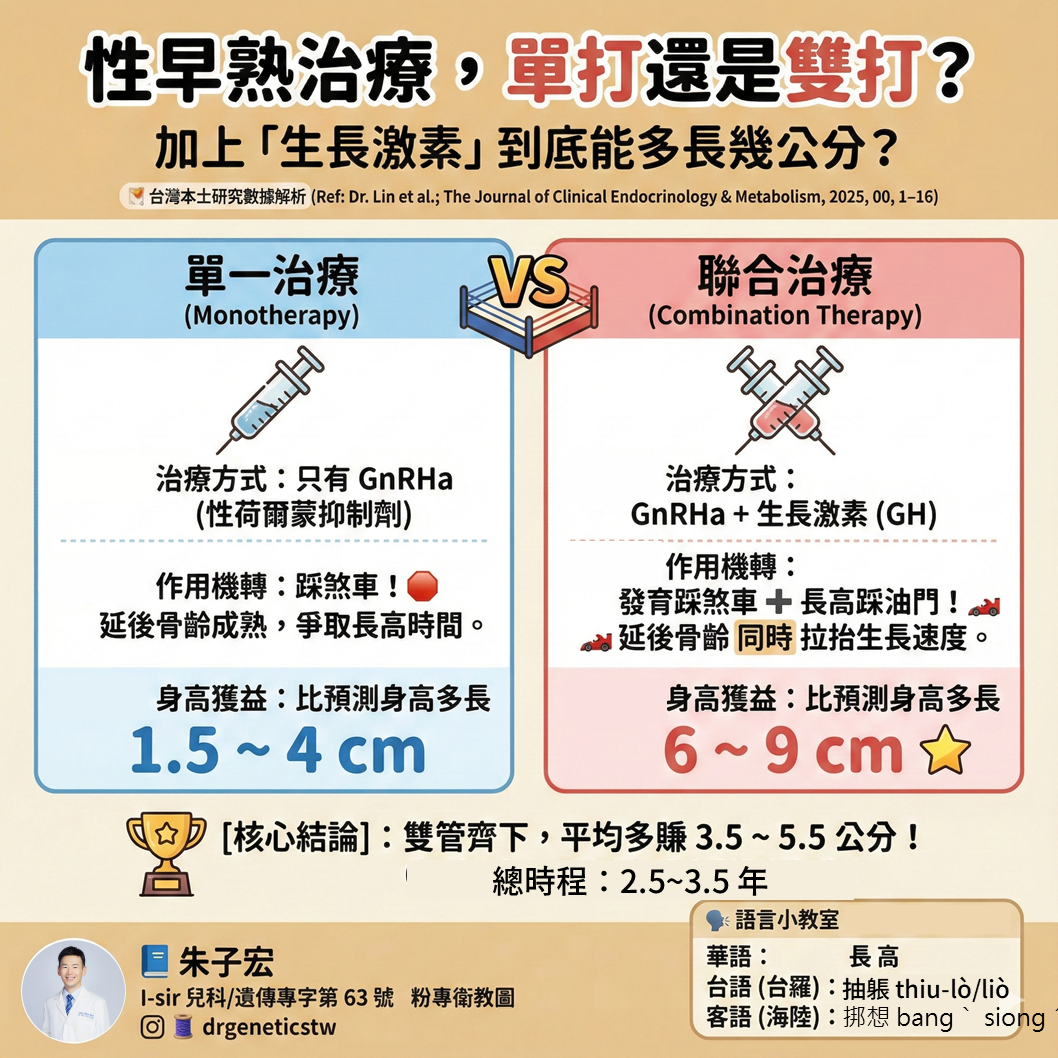
在兒童成長門診,家長最常問我:「朱醫師,打了性早熟抑制針(GnRHa)骨齡是守住了,但孩子長高速度變慢,會不會最後反而長不高?」
這不是家長的過度焦慮,而是臨床上常見的挑戰。今天我們就用台灣本土的大數據——包含我的學長林建銘醫師參與的高品質研究,分析超過 5,000 名男女生的使用經驗,來看看「單打」與「雙打(與生長激素聯合療法)」的實戰差異。

為什麼單用 GnRHa 可能「長不贏」?
中樞性性早熟(CPP)的治療目標是「爭取時間」。GnRHa 就像強力的煞車,能抑制性荷爾蒙,讓骨齡(Bone Age)不要跑得太快。
- 生長速度的兩難: 性荷爾蒙雖然會催熟骨齡,但它同時也是長高的「加速器」。當我們用 GnRHa 把加速器關掉時,孩子的生長速度(Growth Velocity)往往會掉到每年 4 公分以下。
- 最終身高的瓶頸: 如果「踏擋仔」(ta̍h tòng-á, 台語的「煞車」)踩得太死,雖然爭取到了時間,但每年長高的公分數太少,最終成人身高(FAH)的獲益可能只有 1.5 到 4 公分。(這裡也可以反方面想:拖著緩長,就慢慢長,一枝草、一點露,天無絕人之路,請看這篇論文。)
台灣 5,266 人實證:聯合療法(GnRHa + GH)的效果
這份研究回顧了台灣多年的臨床數據,針對預測身高(PAH)不理想的孩子,給予了「煞車(GnRHa)+ 油門(GH 生長激素)」的組合。

數據說話:到底多長了幾公分?
根據這群病童的追蹤結果,我們發現:
- 療程時間: 這些研究對象平均接受了 2 到 3.5 年 的持續治療。
- 身高差異: 單打 GnRHa 的組別,最終身高獲益相對保守;而聯合治療組(GnRHa + GH)平均比預測身高多長了 6 到 9 公分。
- 淨獲益(Net Gain): 比起單用 GnRHa,加上生長激素平均能讓孩子多贏得 3.5 到 5.5 公分。
臨床操作細節大公開
朱醫師在診間常被問到的細節,研究中也有標準答案:
- 給藥週期: 研究中的 GnRHa 多採一個月一針(Monthly Depot),但目前臨床已有三個月一針的長效劑型,效果同樣穩定。而生長激素(GH)則維持每日注射(Daily),模擬生理分泌規律。
- 什麼時候「畢業」? 研究建議的停藥點(骨齡)為:
- 女孩: 骨齡 12.5 歲。
- 男孩: 骨齡 14 歲。 (不過要繼續使用,也不是不行,只是效果當然較弱)
朱醫師的真心建議:誰需要「雙管齊下」?
並非每個CPP的孩子都要打生長激素。如果您的孩子在治療過程中,生長速度明顯放慢,或是預測身高遠低於遺傳身高(女孩 < 150 cm),這時「聯合療法」就是一個值得考慮的投資。
長高是一場馬拉松,我們不僅要跑得久,更要跑得穩。
醫學台語

醫學客語

英文摘要
Context: Central precocious puberty (CPP) can reduce adult height. Studies comparing the efficacy of gonadotropin-releasing hormone analogue (GnRHa) monotherapy with combination therapies show inconsistency.
Objective: This work aims to synthesize evidence comparing the effects of GnRHa monotherapy and combination therapies on height-related outcomes in children with CPP.
Methods: Data sources included PubMed, EMBASE, Cochrane Library, Wanfang Data, and CNKI through December 31, 2024. Study selection included randomized controlled trials (RCTs) and cohort studies involving children aged 12 years or younger with CPP or early puberty, reporting height-related outcomes and a follow-up of 6 months or more. Data were pooled using common- or random-effects models and reported as mean differences (MDs) with 95% CIs for primary outcomes, including height gain (adult height minus pretreatment predicted adult height [PAH]), PAH change (posttreatment PAH minus pretreatment PAH), and growth velocity (GV) in children with CPP.
Results: A total of 70 studies (30 RCTs and 40 cohort studies; 5266 children) were included. Growth hormone (GH) combination therapy significantly improved PAH change (MD, 3.48 cm; 95% CI, 2.98-3.98) and GV (MD, 1.82 cm/y; 95% CI, 1.32-2.31) in RCTs, and height gain (MD, 3.81 cm; 95% CI, 2.77-4.84) and PAH change (MD, 3.06 cm; 95% CI, 2.26-3.86) in cohort studies, compared with GnRHa monotherapy. However, high heterogeneity remains across outcomes, even after subgroup analysis of treatment duration and GH dose, which limits the certainty of these findings. Stanozolol, oxandrolone, and estrogen showed improved growth outcomes, although evidence was limited. Longer treatment durations and higher GH doses were associated with greater benefits.
Conclusion: GH combination therapy enhances growth outcomes in children with CPP compared to GnRHa alone. Stanozolol, oxandrolone, and estrogen show promise but require further research. Personalized combination regimens and additional long-term RCTs are needed, particularly involving male patients and non-GH adjunctive therapies.
Keywords: central precocious puberty; early puberty; gonadotropin-releasing hormone analogue; growth hormone; human growth.
論文小結
Conclusion
Our meta-analysis demonstrates that combining GH with GnRHa therapy results in significant improvements in growth outcomes for children with CPP. Combination therapies such as ST, Ox, and estrogen also show promise, though the evidence remains limited.
A treatment duration of 2 years or longer and high GH doses of 0.3 mg/kg/week (大約為 42.9μg/kg/day) or greater appear to be optimal for promoting growth. However, the certainty of these findings is limited by substantial overall heterogeneity across the included studies.
Furthermore, given the overwhelming majority of participants being female (>98%), the applicability of these findings to boys with CPP is highly uncertain. Therefore, while clinicians should consider personalized treatment strategies on the basis of these findings to optimize growth potential and support healthy pubertal development, interpretation must remain cautious due to the high overall heterogeneity and the lack of generalizability to male and non–East Asian cohorts.
Further research, particularly in male (本研究多數為女生) and multinational cohorts as well as long-term RCTs, is warranted to establish the long- term safety and efficacy of these combination therapies.
發表迴響